Witches of Salem

October is an appropriate time to discuss this part of our nation’s past. In fact, when people think of Salem, they think of the witch trials in 1692. Salem has a much longer and interesting history. My character, Will Rees, visits Salem slightly more than one hundred years later. But the memory of those trials and the witches are present in physical reminders even today.

First, I want to note that reparations were made to the families in the early 1700’s. This does not mean that belief in witches and witchcraft ended. It did not. Accusations and trials continued to the early 1800’s. Mother Ann Lee, the spiritual force behind the Shakers, was arrested on a charge of blasphemy in the 1780’s and could have been hung as a witch. However, it was upstate New York, and almost exactly one hundred years later and she was eventually released.

What happened in Salem?

Well, it is believed the witch hysteria began in the household of Reverend Samuel Parris. A slave called Tituba told stories of her religion which featured voodoo and folk magic to the girls in the  household. One of the practices was the baking of a Witch Cake (one of the ingredients being the urine of the girls – yuck) that was then fed to a dog. Another ingredient was rye.

Since a fungus grows on rye during wet conditions and that fungus produces a toxin that is similar to LSD, rye has been implicated in not only the witch hysteria here but in Europe as well. Perhaps I am looking at it from the perspective of a twenty-first century woman but my first question when I was going on the tours was why these so called responsible adults were listening to a bunch to teenage girls. I’d be instantly suspicious I can tell you.

In any event, before it was over, 150 people were imprisoned and 19 people – and two dogs- were hanged. One man, Giles Corey, was pressed to death. He cursed all future Sheriffs of Salem to die of some chest (respiratory) illness. Apparently most have, but in an era without antibiotics (forget about good hygiene or healthy food) I don’t think that is surprising.IMG_2520 IMG_2555

Salem offers a number of dioramas and costumed reenactments of this period.

Salem, past and present

One of the things I like to do when researching a book is visit the location where it is set. I did that with Salem when I was writing Death in Salem.

death in salem


I like getting the feel of the place and a sense of the geography.

Salem is a good place to research since they have kept a lot of their past. Not all of it but enough. And a number of reminders of Salem’s past. and the past of the United States, are still present. The Burying Point, the cemetery, is there. I like that you can still visit this place and see the headstones from the distant past.

Not the accused witches, however. Witches were not allowed to be buried in consecrated ground so  were dumped. Families, although forbidden to do so, frequently found the bodies and buried them properly. This meant a great deal in this religious past. But the burying point does have memorials to these men and women. (even two dogs were accused and executed!)

IMG_2542

IMG_2540


The witch trials are well remembered and some of the houses were built in that time, 400 years ago.

IMG_2633


Salem still has many houses from the period of the merchantmen also. Below is the Derby house, built within sight of Derby wharf. Although there are many fine houses on the waterfront, a short walk to Chestnut Street reveals a block of beautiful houses, many from the late 1700’s.

IMG_2565


As the merchantmen grew wealthy, they built houses on Chestnut Street. And many of these houses are still occupied.

Although the 1790’s are not ancient compared to Europe and their long history, for these United States it represents the early part of our history and so I find it exciting.


Sisters in Crime blog hop

As part of Sisters in Crime SINC-UP blog round robin (www.sistersincrime.org/BlogHop) I thought I would address the question: what authors have inspired you?


First and foremost, Agatha Christie. I have read all of her books, some of them multiple times. The success of the many dramatizations and most recently the PBS series, several with different actresses for Miss Marple and of course the wonderful David Suchet as Hercule Poirot, speaks to the enduring popularity of Christie’s works. There is even a new Hercule Poirot mystery coming out by a different author who, in an article in Library Journal, said she was trying to remain faithful to the original character.


Why is Christie so popular?


Certainly not her characters. Although I find her detectives interesting, Christie employs a variety of stock characters: the silly maid, the ne’er-do-well heir, the wealthy older widow, the vicar and so on. The most interesting thing that can be said of these characters is that they hearken back to an era where middle class families had maids. This is a time not too distant from our own – I know people who remember the thirties – but in many ways it is as much a foreign country to us as ancient Rome.


But the plots, the plots are incomparable. She plays fair and always puts in enough clues so a really sharp reader can figure out the ending. But she is skilled at putting in a lot of red herrings so unraveling the puzzle is not so easy.


She is the Queen of amateur detectives. Miss Marple and Poirot and Tommy and Tuppence and the others do not operate in a world of writs, and Miranda warnings and all the rest. That’s why her detectives have to explain the resolution to identify the killer. Then the killer has to confess so either a tame policeman like DCI Japp can haul him away or he (or she) can commit suicide, thereby saving the police from having to develop a case with pesky things like evidence. I appreciate that model since I write historical mysteries set in a time without a framework of laws and law enforcement professionals. And that doesn’t even mention aids like fingerprints or DNA.


Other inspirations are Barbara Hambly (writer of the Benjamin January mysteries set in the New Orleans of the 1830’s). Now, her characters I find unforgettable, and not just January himself. His sisters, his friends, even the murderers he hunts are all fully-fleshed out characters. Ask me to tell you the story of even the first January novel, which I read years ago, and I can. They are that memorable.


The other piece she does really really well is setting. What a strange culture this was, exotic and captivating all at once. In my opinion, an author not to be missed.


Another author who is rightly famous is the incomparable Anne Perry. She is very good at evoking the setting: Victorian England with all its pretensions and hypocrisy, especially sexual hypocrisy. But I read her primarily for her characters, especially the Charlotte and Pitt series. I feel as if I know them personally. Any author can aspire to writing such believable characters.


Finally, there are the wonderful Ellis Peters’s Cadfael mysteries. The medieval setting and the world of the cloister is so real it serves almost as another character.


Surely there are male authors who have inspired me? Indeed. One of my absolute favorites is Peter Tremayne, a pseudonym for a Celtic scholar. He writes about seventh century Ireland and Sister Fidelma. A woman who is both a religious and a brehon (judge). During the course of the series she marries, this early form of Christianity was quite different than the form that became known as Roman Catholicism.


Surely there are other writers I read? Of course. I loved the 87th precinct by Ed McBain but more as something different from my own experience. I enjoyed the Tony Hillerman mysteries. He did such a good job of putting you into the Navaho experience and both Chee and Leaphorn are wonderful characters. I’m glad Anne Hillerman has taken on her father’s mantle and is continuing the series. C.J. Box’s Joe Pickett mysteries and the superb Longmire mysteries from Craig Johnson are character driven and action filled mysteries.


But it is the historical mysteries that I read of tips on ‘how to do it’. The setting is not just a background for the characters and the unraveling of the mystery, but an integral part of the mystery itself.  So you might find that a Crusader, infected with leprosy, is both judge and murderer. Or syphilis is the cause of a graveyard of dead babies. Or a passionate religious disagreement leads to murder.


I try hard to match such seamless interweaving of mystery, character and setting but although easy to admire, it is very hard to do.

Check out other blogs by some of the Sisters in crime blog hop and also my special friend Dora Machado at htttp://www.doramachado.com/

Salem and New book Cover

I can’t praise the graphics department of Minotaur (st. Martin’s) enough. Every cover has been outstanding. I love the new one, for Death in Salem, partly because it is so accurate to the look of Salem’s waterfront.  Take a look. Here is my picture, taken in May of this year.

IMG_2573


and here is the book cover for Death in Salem.

death in salem

See what I mean?

More about Salem

My new Will Rees mystery will be coming out next spring. This time, he travels to Salem, Mass and, of course, is embroiled in a mystery.

I went to Salem to research the area.

I mixed real people and characters of my own invention but tried to keep the facts of the sailing industry accurate.

This is a photo of the custom house, but a few years later. During the 17902, the location switched among several buildings.

custom house

This is the India store. I based the store run by my widow on this store.

india store


and this is a museum representation of a counting house. Again, I based my description on this.

counting house

I’m sure I will get questions on the tunnels underneath Salem. Although I read about them, I did not see any. I guess it’s time for another road trip!

Salem and the scarlet Letter

After my research journey to Salem this spring, I decided to reread both The Scarlet Letter and the House of Seven Gables. I read both but a long time ago – because they were on reading lists. Let me tell you, I missed a lot in The Scarlet Letter as a fourteen year old reader. I don’t know yet what I missed in The House Of Seven Gables – I haven’t read it yet. but I’ll be willing to bet I missed most of the important points.

IMG_2613


It was clearly owned by a wealthy family.

IMG_2622

There really is a house of the seven gables. Who knew?


This is one of the ceilings. and there was an attic for the servants and slaves to sleep in.

Puritanism and the witch trials are clearly part of the history – and not just the tourist parts either. We stopped at the Old Burying Point.

IMG_2540


There were a lot of small gravestones for little children. Some families lost five and six kids. Heartbreaking. But one of the most poignant were the large memorials to the people executed during the witch trials. Since they had been found guilty of witchcraft the victims could not be buried in consecrated ground. It is thought the families slipped out at night and found the bodies and gave them a decent burial. But no one knows for sure. And the graves of course cannot be located.

IMG_2542


Each memorial is inscribed with the name and date of execution of one of the nineteen victims. Sobering.

I read The scarlet Letter with an entirely different perspective.

Here’s a fun fact about Hawthorne. He did not want to be associated with the Judge who sent the accused to the gallows ( a direct ancestor) so he added a w to his name.

My garden = rainforest


It is amazing how well a garden grows without critters. Shelby is doing a good job of keeping everything at bay.OLYMPUS DIGITAL CAMERA


Shelby in pursuit


My tomatoes, cucumbers, zucchini and beans are taking over.

rainforest


But this is what they look like harvested.

cukes and zucchini


And I am going to have tons of tomatoes. This is ONE plant.

tomatoes


Cucumbers and Las vegas

cukes

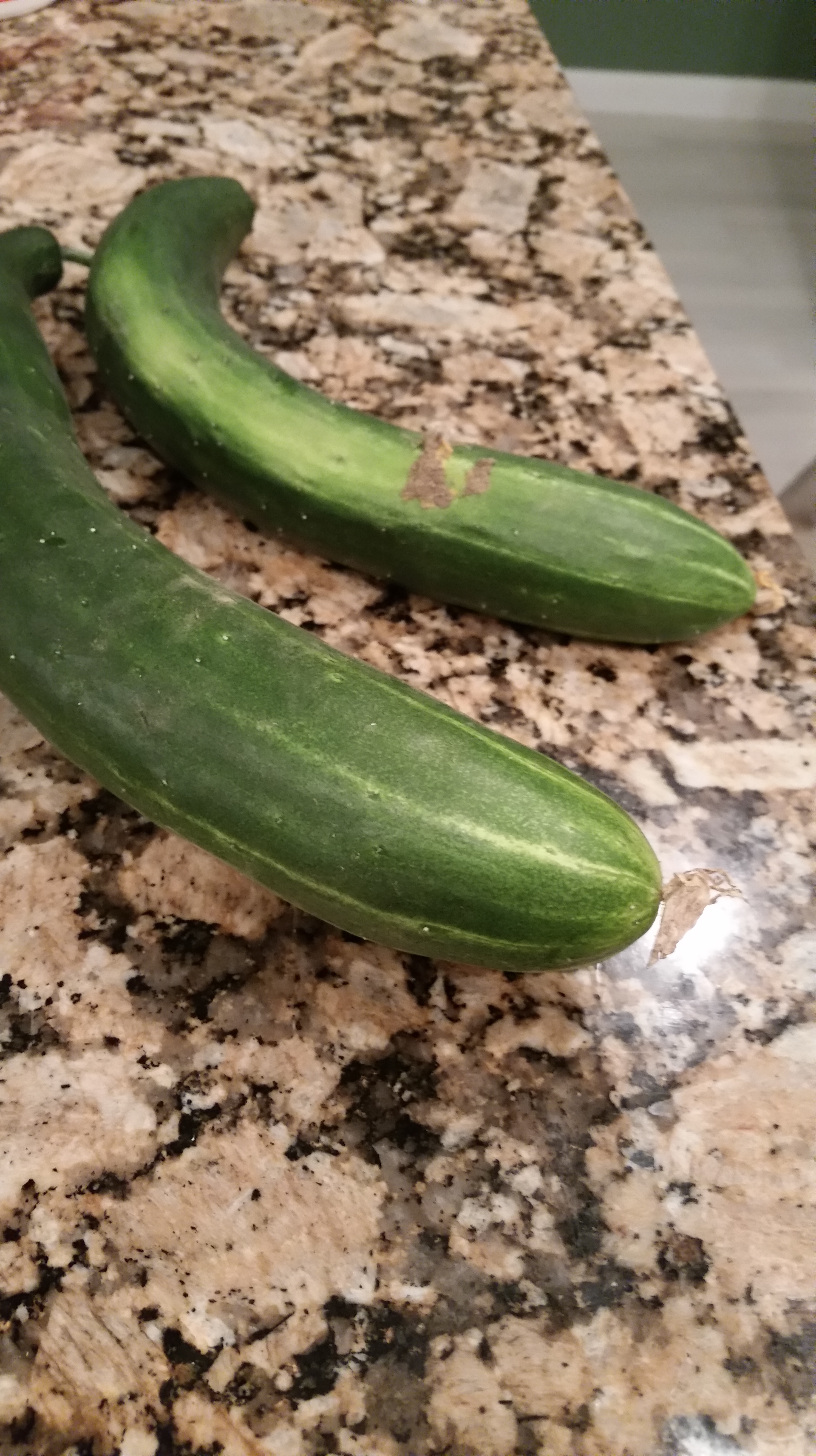
Four of these beauties were waiting for me when I returned home from ALA. I mention that to show the difference in the climates. Las Vegas is in a desert and is unbelievably hot and dry.

I do not like Las vegas, and not just the climate. (as a gardener, the whole desert thing doesn’t work for me). But I also don’t drink, smoke or gamble. the casinos have no windows or clocks since they are trying to encourage people to gamble. Women in skimpy costumes walk around pushing cocktails. And the place smells of smoke. I admit, though, that I am a little more tolerant of the smoking. at least that doesn’t put someone’s family’s financial future in jeopardy.

More than anything, I got the feeling that I had stepped back in time, to the glory days of Frank Sinatra and the Rat Pack.

vegetable garden

Now that the ground hog is gone, my garden is doing well. Something, and I think it is a rabbit, is biting the tops off my peas. But all the other plants are lush.

First, a note about recycling. I recycle all my kitchen garbage. Not bones or anything like that but all the peelings, spoiled fruit, coffee grounds and tea leaves. I keep a bucket in the kitchen to put the stuff in.

bucket

When the bucket is full I take it outside to Big Bertha, my recycling barrel.

bertha

I used to have a barrel that looked like darth Vader’s helmet but I couldn’t turn it. This one turns. In the fall, I spread the compost on the garden, cover it with black plastic, and turn it in to the soil in the spring. I took clay soil and after five years of this turned it into great garden soil. Then we moved but that is another story.

Anyway, with what I have in the earth boxes on the garden I have ten tomato plants. Why so many? I can’t bear to kill any of them so I let them live. And I will have tomatoes coming out of my ears this year. All the plants already have tons of flowers.

tomato flowers

We have already eaten swiss chard.  the cucumbers and squash are covered with blossoms.

s. cukes and squash

Finally, I have several rows of green beans. I fill in empty rows with beans. They grow well, produce heavily and, like peas, put nitrogen into the soil.

beans

I also began a row of turnips. The beets are doing OK. My root crops don’t do as well as I’d like. But next year I plan to put in a row of kale and a row of spinach. I am pondering potatoes.